Oxford Centre for
Hindu Studies Online

Chapters 7 to 12 are the heart of the Bhagavad-gītā in both senses: the middle six of its eighteen chapters, and the devotional core of its teaching.
Here Kṛṣṇa speaks for the first time about his own nature — the Supreme Deity who manifests, pervades, and sustains the whole world — and reveals bhakti (devotion) as the most direct spiritual path. It is a path the Deity meets in kind, returning devotion with love and granting liberation as an act of grace.
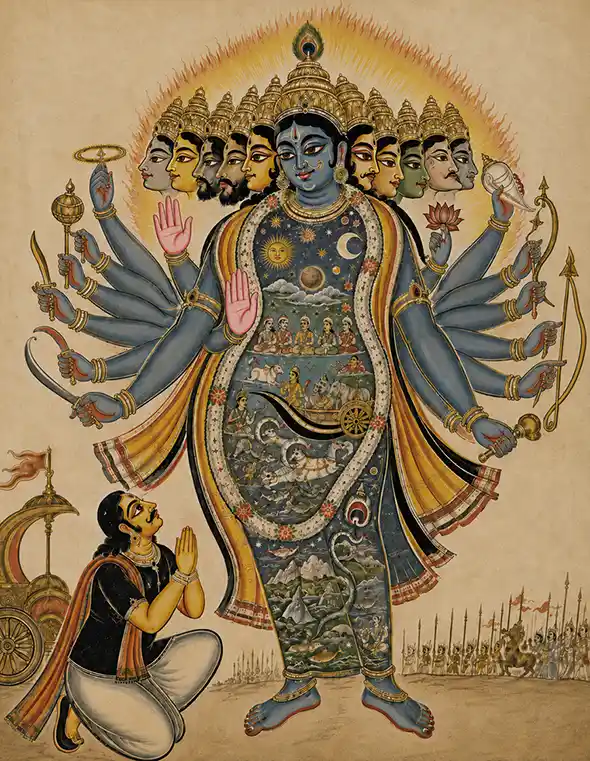
These chapters are often considered the Gītā’s greatest gift to Indian religious thought. Their vision, culminating in Arjuna’s overwhelming sight of the universal form and Kṛṣṇa’s closing words on divine love, shapes devotional life across India.
Over seven sessions, Dr Sutton leads a close, verse-by-verse reading of Chapters 7 to 12, drawing throughout on the classical commentators.
Bhakti, God, and the Soul’s Journey
Kṛṣṇa begins to disclose who he really is: the Supreme Deity who both creates the world and pervades every part of it. He draws a line between those who grasp this and turn to worship and those held back by material desire. He sets out bhakti as the highest form of spiritual practice.
The terms that close Chapter 7 prompt a run of questions from Arjuna. Most Kṛṣṇa answers briefly, but one he takes up at length: how to hold the mind on the Deity at the moment of death and why that final thought carries such weight.
Opening with what Kṛṣṇa calls the most confidential of all knowledge, this chapter of returns to the Deity’s presence in all things and the devotion that answers it. It contains some of the most direct assurances the Bhagavad-gītā offers to those who worship him.
Arjuna accepts all he has been taught, then asks the obvious question: how can the Deity actually be perceived in the world? In reply, Kṛṣṇa names a cascade of wondrous beings and things, each one a glimpse of his own divine glory.
Arjuna wants more than examples; he asks to see the Deity directly. Kṛṣṇa grants it, revealing the viśva-rūpa, the universal form that contains the whole of creation. The vision is magnificent and more than Arjuna can bear.
The vision turns terrifying. Arjuna watches time itself devour all things and begs Kṛṣṇa to return to his familiar form. Kṛṣṇa explains that a sight like this can only be reached by pure, undivided devotion.
The close of this section is the summit of the Bhagavad-gītā’s teaching on devotion. Kṛṣṇa describes the way of life of the true bhakta (devotee) and repeatedly promises that those who love the Deity are met with his love in return.

Course Tutor
Nick is the Director – and the heart and soul – of the OCHS Continuing Education Department. He is a dedicated teacher with decades of experience in making sometimes-confusing traditions relevant. He has created over a dozen online courses and is working on many more. He has written translations and commentary on Bhagavad Gītā and the Yoga Sūtra. Nick received his Phd from Lancaster University (1995). His thesis was on the religious teachings of the Mahabharata.