
Oxford Centre for
Hindu Studies Online
Oxford Centre for
Hindu Studies Online
 New
Why do people perform rituals, tell creation stories, make sacrifices and describe religious experiences? In Comparative Religion we study religious traditions through comparison. We examine similarities and differences in beliefs and practices, asking what we can learn from these comparisons and where they might be misleading.
In this eight-session course, Professor Gavin Flood explores these questions through examples from around the world: the Hajj, Kumbha Mela and Lourdes; sacrifice in Nepal; accounts of creation in Genesis and the Upanishads; and Jane Goodall’s observations of chimpanzees. Along the way, he introduces some of the key ideas and debates in comparative religion, examining both the value and the limitations of comparing traditions.
No previous knowledge is required.
By the end of the course, you should be able to:
• Compare religious practices and beliefs across traditions using established scholarly approaches.
• Identify similarities and differences between rituals, myths and doctrines, and explain why some comparisons can be misleading.
• Recognise the main approaches to studying religion: historical, sociological, psychological and phenomenological.
• Discuss the strengths and limitations of comparative religion as an academic discipline.
Why compare religions, and what can comparison tell us?
Comparison can reveal things that a single example cannot. Comparing how water boils at different altitudes, or how kinship works in different societies, helps us understand shared patterns and significant differences. This opening session asks what we mean by religion, why scholars compare traditions, and how they do so. We begin with practices such as the Christian Eucharist, Buddhist meditation, Muslim prayer, Hindu puja and Jewish Passover, using theory to help us make sense of what people do.
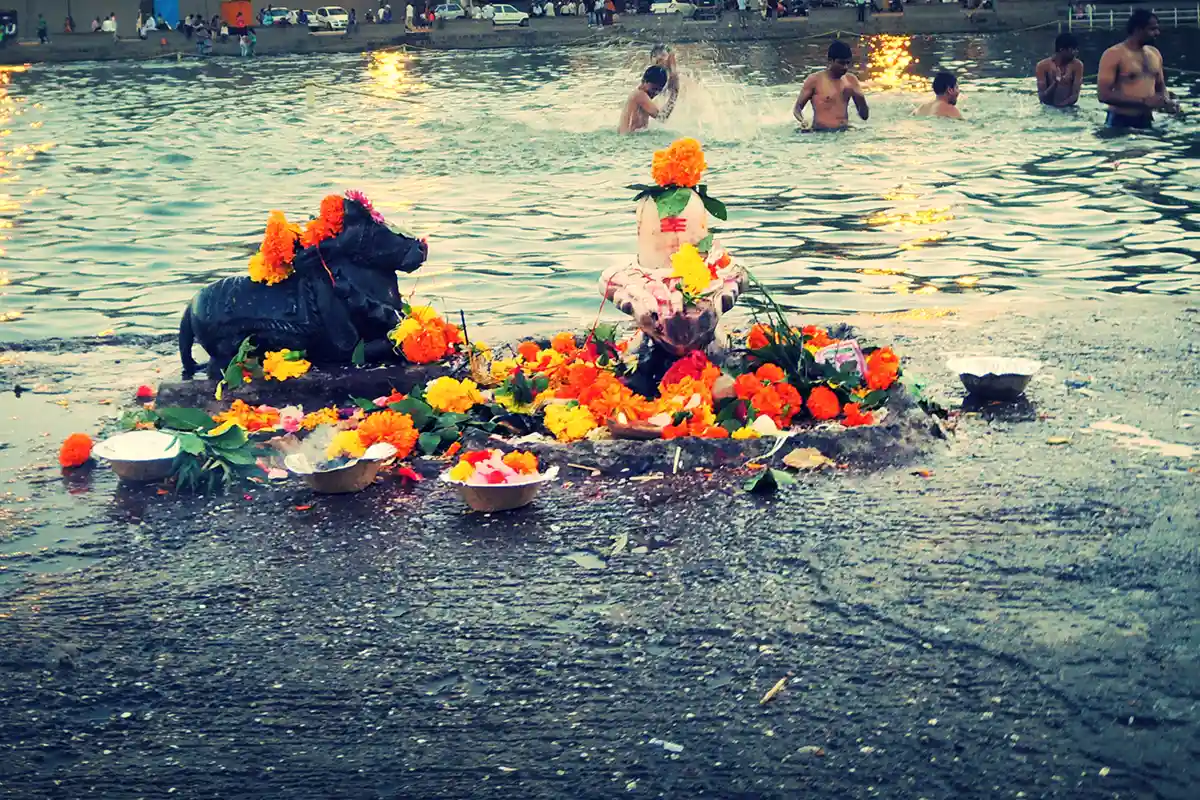
Kumbh Mela (Source Bombman, Mumbai, India)
Case study: Pilgrimage in Islam, Hinduism and Christianity: the Hajj, Kumbha Mela and Lourdes.
Provided reading: Jeffrey J. Kripal et al., Comparing Religions: The Study of Us That Changes Us, 2nd ed., Introduction.
What makes an action a ritual, and what does it do?
Ritual behaviour is found across human societies, and some forms of patterned behaviour can also be observed in other animals. Is ritual meaningful in itself, or does its significance come from beliefs and the communities that practise it? Émile Durkheim saw ritual as a way of strengthening social bonds. Through Edith Turner’s account of Ndembu healing rites, we consider what ritual does, how it can be understood by participants and observers, and why the objects used in ritual matter.
Case study: Edith Turner’s account of Ndembu healing rites.
Provided reading: Edith Turner, Experiencing Ritual: A New Interpretation of African Healing, ch. 6, ‘The Second Ihamba: The Performance for Meru’.
What is sacrifice, and why has it remained important in religious life?
Sacrifice has played an important part in religious life across cultures. Does it channel a community’s violence towards a scapegoat, or express a transformation of the self? What happens when societies move away from sacrifice: does it survive in symbolic forms or take on new functions? We examine these questions through practices in Nepal, including those found among Hindus and Buddhists.
Case study: Sacrifice in Nepal and its place in Hindu and Buddhist traditions.
Provided reading: Marie Lecomte-Tilouine, Sacrifice and Violence: Reflections from an Ethnography in Nepal, ch. 5, ‘The Buffalo Sacrifice’.
Why do myths from different cultures sometimes resemble one another?
Freud and Jung offered psychological explanations for religious myths. Freud saw religion as an expression of unconscious desires and fears, while Jung argued that recurring images reflect shared psychological patterns, or archetypes. Michael Witzel offers another explanation for similarities between myths: historical transmission and a common origin. We consider the strengths and limitations of these different approaches.
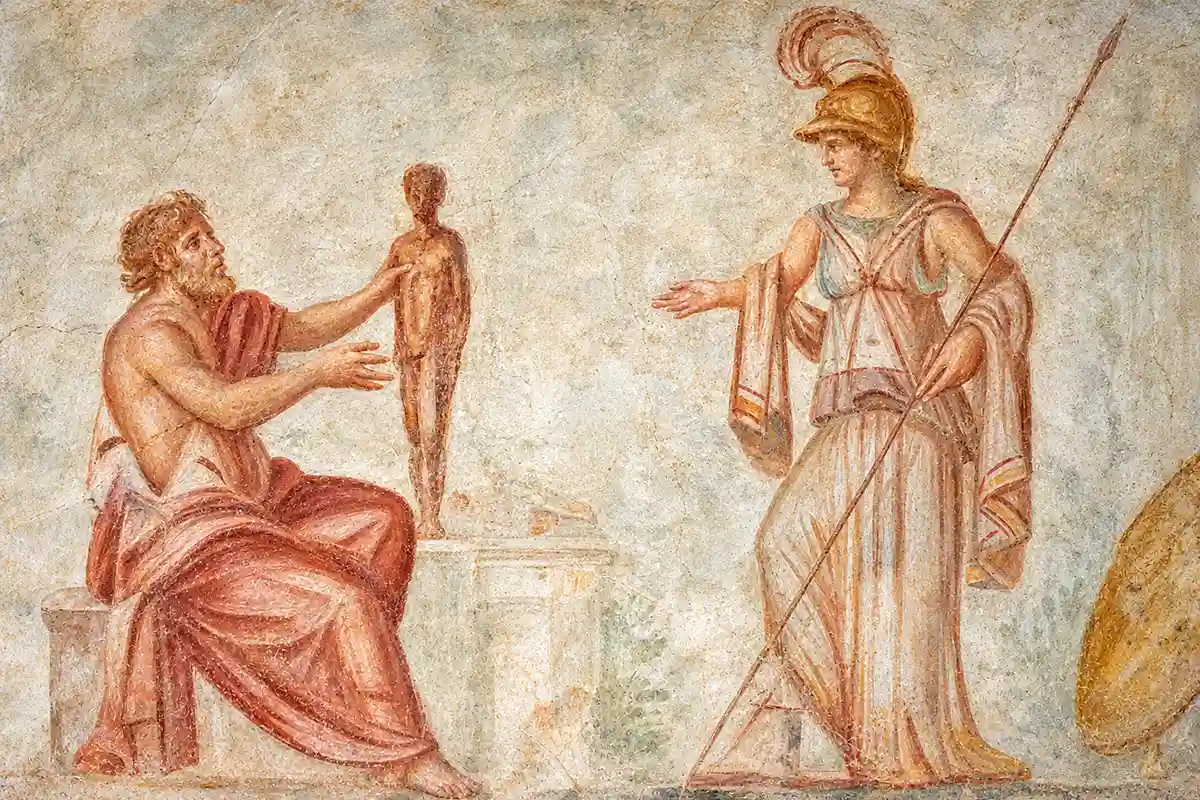
Prometheus creating man in the presence of Athena, Museo della Via Ostiense, Rome
Case study: Creation accounts from Genesis and the Bṛhadaraṇyaka Upanishad.
Provided reading: E. J. Michael Witzel, The Origins of the World’s Mythologies, Introduction.
How should we understand experiences that people describe as encounters with the divine?
William James helped establish the modern study of religious experience through The Varieties of Religious Experience (1902). Experiences such as the Buddha’s enlightenment or Teresa of Ávila’s encounters with Christ raise difficult questions: can they be explained in psychological terms, or do they provide a form of knowledge, as some traditions maintain? We consider these questions through examples from different religious traditions.
Case study: The medieval mystic Marguerite Porete and the twentieth-century thinker Simone Weil.
Provided reading: Anne Carson, Decreation, ‘Decreation: How Women like Sappho, Marguerite Porete and Simone Weil Tell God’.
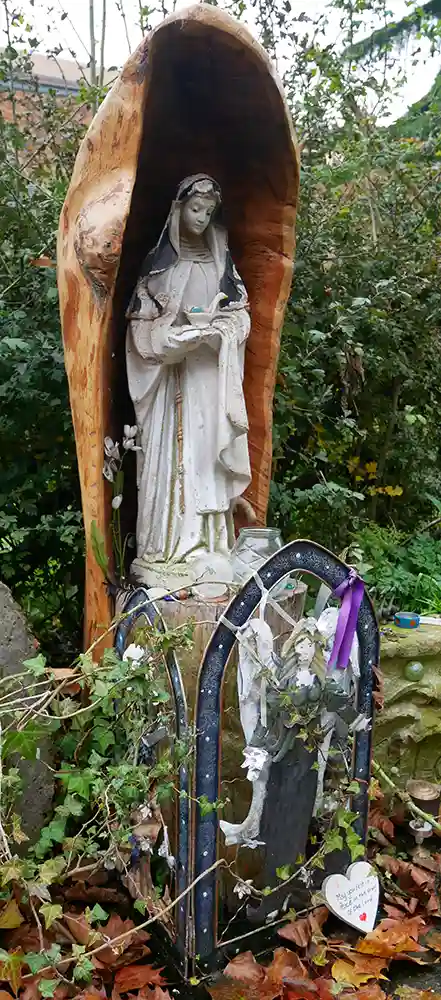
For Émile Durkheim, religion could be understood in terms of its role in binding communities together. Rituals can reinforce a group’s shared identity and, in some settings, have a healing function. This session considers that sociological approach, looking at collective worship alongside the rituals documented by anthropologist Sondra Hausner at Crossbones Graveyard in Southwark.
Case study: Worship in temples and churches, compared with the newer rituals documented by Sondra Hausner in Southwark.
Provided reading: Sondra L. Hausner, The Spirits of Crossbones Graveyard: Time, Ritual, and Sexual Commerce in London, pp. 95–114.
Did religious traditions in different civilisations undergo similar changes?
The ‘Axial Age’ is a hypothesis about parallel developments in religion and thought in different civilisations during the first millennium BCE. Karl Jaspers argued that some traditions moved towards new ideas of transcendence and a stronger emphasis on ethics. We examine the hypothesis through examples from India, Europe, and China, and ask how far it helps explain religious history.
Case study: India, Europe and China, the principal examples used to illustrate the Axial Age thesis.
Provided reading: Charles Taylor, ‘What Was the Axial Revolution?’, in The Axial Age and Its Consequences.
Can evolution help explain the origins of religion?
How far can religious behaviour be understood in evolutionary terms? E. O. Wilson emphasised the role of genes in human behaviour; John Bowker challenged such explanations of religion. Drawing on Jane Goodall’s observations of chimpanzee communities, we ask whether non-human animals show behaviours we might call religious, and whether religion is possible without language. These questions also raise the issue of how much evolution can explain on its own.
Case study: Jane Goodall’s research on chimpanzee communities, alongside suggestions that wonder, emotion and reverence might help us think about religion beyond the human species.
Provided reading: Gavin Flood, Religion and the Philosophy of Life, ch. 2, ‘The Emergence of Religion’.

Course Tutor
Prof. Gavin Flood is Professor of Hindu Studies and Comparative Religion at Oxford University, Academic Director of the Oxford Centre for Hindu Studies, and Senior Research Fellow at Campion Hall. His publications include Religion and the Philosophy of Life (2019), The Truth Within: A History of Inwardness in Christianity, Hinduism, and Buddhism (2013), The Importance of Religion: Meaning and Action in Our Strange World (2012), and The Ascetic Self: Subjectivity, Memory, and Tradition (2004). He is also the General Editor of the series ‘The Oxford History of Hinduism’ and is a Fellow of the British Academy.