Oxford Centre for
Hindu Studies Online
Oxford Centre for
Hindu Studies Online
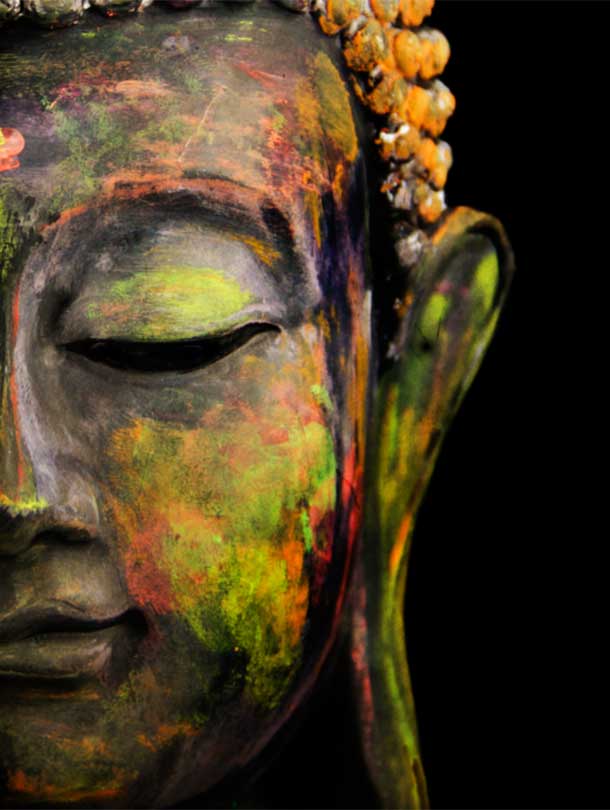
The Buddha has become a symbol of the peace that is possible for the human mind, yet in his own time he was a revolutionary teacher, one who set aside gender and caste and held that the mind’s potential is open to everyone. This course examines his teaching on meditation and the mind, and how it fits into its wider Indian background.
We begin with the life of the Buddha as a paradigm for Buddhists of every tradition, then follow the eightfold path and its embodiment of wisdom, ethics, and concentration. Later sessions turn to the psychology of the Abhidhamma, the story traditions of the Jatakas and the Dhammapada, and the practical advice of Buddhaghosa’s Path of Purification, the great manual of the meditative life.
The course is written and tutored by Dr Sarah Shaw, a faculty member and lecturer at the University of Oxford, fellow of the Oxford Centre for Buddhist Studies, and the Khyentse Foundation Reader in Buddhist Studies at the University of South Wales. It is based on her book The Spirit of Buddhist Meditation, and every student receives an electronic copy. The course runs over seven weeks, with nearly five hours of video lectures, a 256-page coursebook, and an essay assessment.
We begin with the Buddha and discuss the meaning of his life for Buddhists ancient and modern. The principle of the middle way is explained and we see how it is enacted in the Buddha’s life, his progress to awakening, and to his teaching career. We examine the life of the Buddha as a paradigm and exemplar for Buddhists of all traditions.
In these sessions, we examine the eightfold path and how it embodies all that is needed: wisdom (panna, aroused by vipassana practice, or insight), ethics (sila), and concentration (samadhi).
There is no meditation (jhana) for the one without wisdom;
there is no wisdom for the one without meditation.
If you have meditation and wisdom, you are near to complete peace (nirvana).
Dhammapada 372
We explore jhana (dhyana in Sanskrit), the classic route to attain right effort, right mindfulness, and right concentration, the last three factors of the eightfold path.
We will also explore texts on Buddhist meditation and how it fits into a larger path, where chanting, listening to texts, and other practices are key features.
These three sessions aim to communicate the richness of the Buddhist meditative tradition, but also its straightforwardness and practicality. People are assigned and taught meditations according to their needs: but all are practising bhavana, and all are dedicated to arousing concentration and mindfulness, leading to the full development of the path.
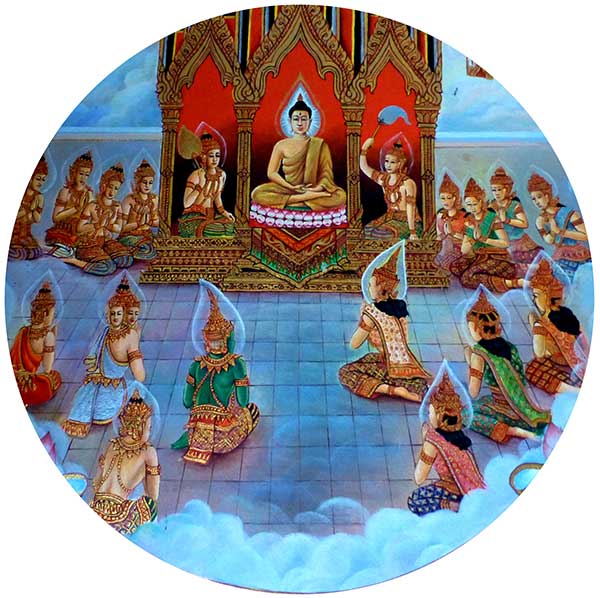
In this session, we explore Buddhist texts on meditation, including some poems by those who became enlightened in the early days of the teaching. In this session we focus on texts that are geared towards developing insight: for instance, the Rathavinita Sutta, which outlines the stages of calm and insight and compares them to a relay race; it has become a classic text for those following a primarily insight meditative path.
It is the Abhidhamma, however, that occupies centre stage in this session. It is the third ‘basket’ of the Buddha’s teaching, after Vinaya (the monastic code) and Sutta (the discourses of the Buddha). The Abhidhamma offers a sophisticated psychological system, a way of understanding events and experiences in meditation and daily life, and gives a sense of insight: into impermanence, continuities of various kinds, and into the ever-changing currents of consciousness as it relates to the body and to the world around.
At the time of the Buddha, many people practised meditation, and attained many diverse states and higher experiences of various kinds. This system appears to have been a way of describing these states, understanding them and placing them within the larger perspective of the Buddhist path.
In this session we explore the story and narrative traditions of Buddhism. As with all Indic religions, the lifeblood of the system can be found in the many tales, myths, legends, and stories of the central figures. Their experiences, adventures, heroic exploits, and meditative successes and failures are how most people learned their Buddhism in Buddhist regions.
We look at the Jatakas, the stories of the Buddha’s past lives as the Bodhisatta, and the Dhammapada stories about meditators’ experiences over many lifetimes.
The Ten Perfections
…the things in this world that bring awakening to maturation, that bring about Buddhahood and that have to be fulfilled by Bodhisattas. Beyond these ten perfections there are no others. And these ten perfections are not in the sky above; they are not in the earth below, nor are they in the directions that start with the east. They are established right in the depths of my heart.
(from the Spirit of Buddhist Meditation)
The last session discusses the practice of jhāna (dhyāna in Sanskrit), a particularly Indic contribution to the practice of meditation, and some Buddhist commentarial advice on its practice. The Buddha’s teachings on this subject appear to differ markedly, in the early days, from those of his contemporaries, but the traditions of India tended to work together and deploy features from one another: it is likely that practitioners in many traditions undertook practices of this kind.
In this session we look at the meditation manual of the great Buddhaghosa, the Path of Purification (Visuddhimagga) and explore some of his advice on this subject. As so often in Buddhist meditation, suitability to the time, place and person are constantly recommended.

Course Tutor
Sarah Shaw is a longtime practitioner and teacher of Buddhism. She is a fellow of the Oxford Centre for Buddhist Studies and faculty member and lecturer at the University of Oxford. She is the Khyentse Foundation Reader in Buddhist Studies, University of South Wales. She has taught and published numerous works on the history and practices of Buddhism, including Mindfulness and The Spirit of Buddhist Meditation.