Oxford Centre for
Hindu Studies Online
Oxford Centre for
Hindu Studies Online
Vedanta and Samkhya are two of the six classical systems of Hindu philosophy, and two that have shaped the tradition most deeply.
In this course we study the great teachers of Vedanta: Shankaracharya and the Advaita school, including his life and works, then Ramanuja and Madhvacharya and their rival readings. We then turn to Samkhya, ending with a close reading of the Samkhya Karika, its principal text.
The course opens with a brief survey of all six systems, so no prior knowledge is needed. It runs over seven weeks, tutored by Dr Raj Balkaran, with weekly video lectures, 119 pages of course notes, and a tutor-moderated discussion forum. For related courses, see Hindu Philosophy: Understanding the Self and Three Short Upanishads.
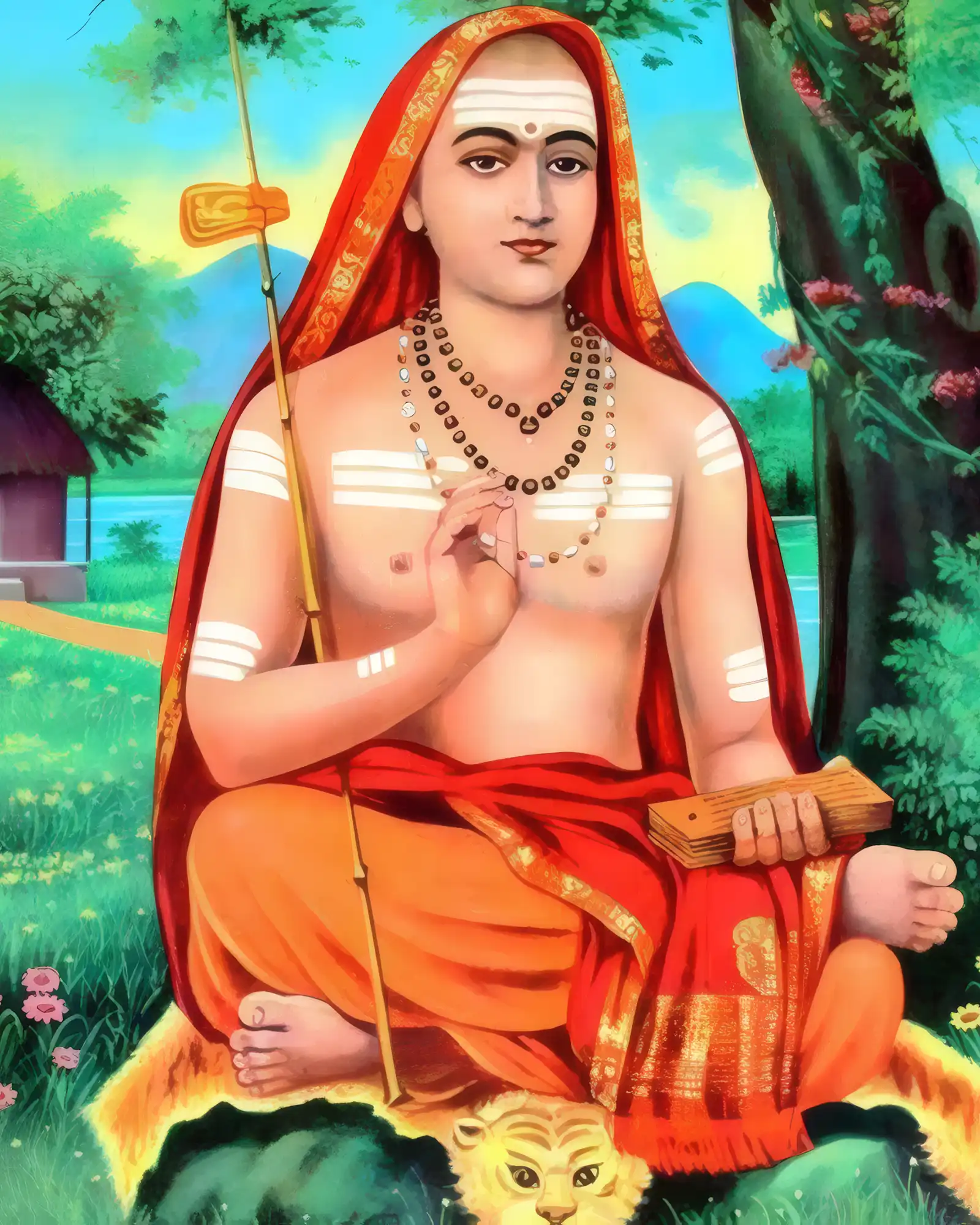
Vedanta means ‘the end of the Veda’: the philosophy drawn from the Upanishads, and the system that has come to define Hindu thought. We begin our study with its most influential school, the Advaita or non-dualist Vedanta, paying particular attention to the teachings of Shankaracharya.
There are said by some sources to be ten biographies of Shankaracharya. Of these, only five seem to exist today, the best known of which is called the Shankara Digvijaya, written by Madhava Vidyaranya in the fourteenth century.
We look at Shankaracharya’s ideas. These are largely built upon the teachings of the Upanishads, on the aphorisms of the Vedanta Sutras, and on the writings of earlier acharyas, most notably Gaudapada.
In this session we are going to look at another of the main schools of Vedanta, the Visishtadvaita (visishta advaita). This is generally associated with the work of Ramanujacharya, a Tamil Brahmin teacher who lived in the South of India in the 11th century AD.
The contribution of Madhvacharya to the overall system of Vedanta is too often minimised or overlooked altogether. We take a look at his work and its relevance.
Few today would identify themselves as adherents of the Samkhya system, yet in the past it appears to have rivalled Vedanta itself. It is tempting to classify Samkhya as an interesting ancient phenomenon with no great relevance to the contemporary Hindu tradition. That would be a mistake: though there are few overt manifestations of Samkhya today, it continues to exert a significant influence over Indian religious thought, and in this session we discover where and how.
For this second of our two sessions on Samkhya we focus on a close reading of the Samkhya Karika, which is widely accepted as the principal text outlining the ideas of the Samkhya system.

Course Tutor
Dr Raj Balkaran is a scholar of Sanskrit narrative texts and the author of The Goddess and the King in Indian Myth (Routledge 2018), The Goddess and the Sun in Indian Myth (Routledge 2020). Having taught comparative religion and mythology at the University of Toronto School of Continuing Studies for a decade, he now Tutors at the Oxford Centre for Hindu Studies where he also serves on the Continuing Education Department’s Course Development Board. Alongside his academic training, he has received extensive spiritual training as part of an oral tradition dedicated to the transmission of Indian wisdom teachings. Integrating his academic and spiritual training, he has founded the online School of Indian Wisdom where he designs and delivers original online courses centred on the practical life wisdom to be found in the philosophical, mythological and spiritual traditions of ancient India. Beyond teaching and research, Dr Balkaran runs a thriving life consulting practice and hosts the New Books in Indian Religions podcast.